
Treatment guide

Dental implants in Marina del Rey

A dental implant replaces the root of a missing tooth, so a crown, bridge or denture has something solid to attach to. This page explains the options by how many teeth you want to replace.

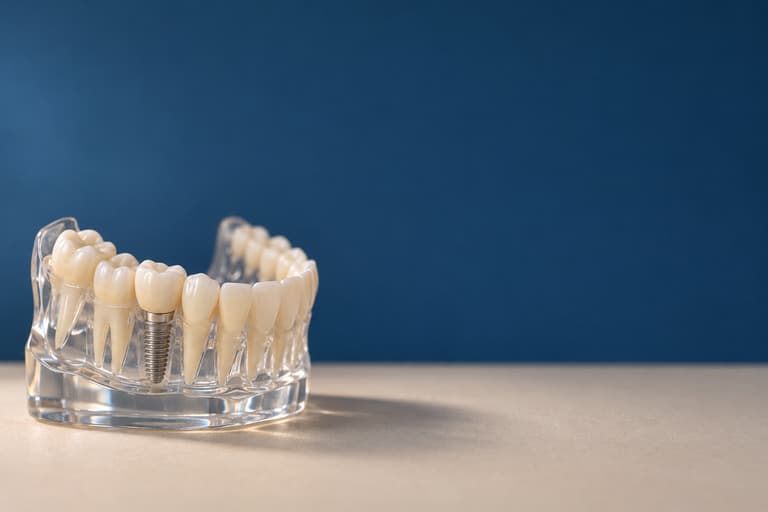
A dental demonstration model showing a single implant, photographed on an ivory surface against a deep blue backdrop (illustrative image)

The three parts of an implant tooth

An implant tooth is three separate parts. Knowing them makes any estimate easier to read, because each part can be listed and priced on its own.

  1. Implant

    A small titanium post placed in the jawbone. It does the job of a tooth root and is not visible once healed.

  2. Abutment

    The connector that attaches to the implant and holds the crown above the gum line.

  3. Crown

    The custom-made tooth you see and chew with, shaped and shaded to sit with the teeth beside it.

The three parts of an implant toothA cross-section showing a crown above the gum line, an abutment connecting it to an implant, and the implant set in the jawbone between two natural teeth.Crownthe visible toothAbutmentthe connectorImplantthe post in the bonenatural toothjawbone
Illustration for education. Your own plan is based on an exam and may differ. Further reading: American Dental Association (MouthHealthy): Implants.

Options by the number of teeth

Each option has its own page. Whether it suits you depends on an exam.

One missing tooth

Single-tooth implant

Fixed

One implant, one abutment and one crown replace a single tooth without altering the teeth beside it.

The implant takes the place of the root and the crown is made to match your other teeth. Because it stands on its own, the neighboring teeth are left untouched and you clean it like a natural tooth.

The alternative is usually a bridge, which is quicker but relies on the teeth on either side.

$699: Implant placement, including exam and X-rays. Not included: CT scan (3D imaging to plan the implant's position), Abutment (the connector), Crown (the visible tooth), Sedation. Offer details
More about single-tooth implant

Two or more teeth

Implants for several teeth

Fixed

Several missing teeth can be replaced with individual implants or with an implant-supported bridge.

When teeth are missing side by side, two implants can often carry a bridge of three or four teeth, so not every tooth needs its own implant.

The alternative is usually a removable partial denture, which rests on the gums and clips to remaining teeth.

More about implants for several teeth

A full arch

Implant-retained denture

Removable

A removable denture that snaps onto implants, so it stays put when you eat and speak and comes out for cleaning.

Two or more implants carry attachments that the denture clips onto. It is steadier than a conventional denture and you still remove it yourself to clean it.

The clips wear with use and are replaced from time to time.

More about implant-retained denture

A full arch

Fixed full-arch bridge

Fixed

A full set of upper or lower teeth secured to several implants. It stays in place and is cleaned in the mouth. Often called “All-on-4” when four implants are used.

A fixed bridge is attached to implants placed across the jaw and is only removed by the dental team. It is the closest option to having your own teeth back, and it needs careful daily cleaning underneath.

Whether a fixed bridge is possible, and how many implants it needs, depends on the bone available and your general health.

More about fixed full-arch bridge

Fixed or removable: how full-arch options differ

Both approaches use implants for support. The difference is whether the teeth stay in or come out for cleaning.

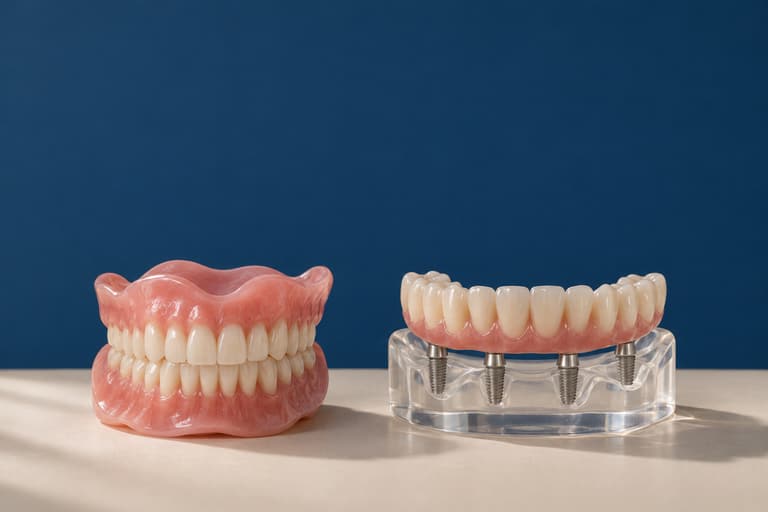
Two dental demonstration models of a full upper arch on an ivory surface against a deep blue backdrop (illustrative image)
ComparedFixed (stays in)Removable (snaps on)
How it attachesA full-arch bridge is secured to several implants. Only the dental team removes it.A denture clips onto two or more implants. You take it out yourself.
Daily cleaningBrushed in place, with floss threaders or a water flosser under the bridge.Removed and cleaned outside the mouth; the implant attachments are brushed too.
How it feelsClosest to having your own teeth; no plate to take out at night.More secure than a conventional denture, with some movement by design.
Upkeep over timeRegular checkups and professional cleaning; parts can wear and need repair.Clips and inserts wear and are replaced periodically; the denture may need relining.
Typical requirementsUsually more implants and more planning.Often fewer implants.

Which option is appropriate depends on an exam, imaging and your health. Neither can be promised before a dentist has seen you.

How treatment usually unfolds

Timelines vary from person to person. These are the common stages.

  1. Consultation and planning

    Exam, imaging and a written plan that sets out the steps, the timeline and the fees.

  2. Placing the implant

    The implant is placed in the jawbone in a minor surgical procedure, usually with local anesthetic.

  3. Healing

    Bone grows around the implant and holds it firmly. This commonly takes a few months, and a temporary tooth may be worn meanwhile.

  4. Abutment and crown

    Once healed, the connector and the final crown, bridge or denture are fitted and adjusted to your bite.

Sources: American Dental Association (MouthHealthy): Implants; U.S. Food & Drug Administration: Dental Implants — What You Should Know.

What shapes the cost

Two people replacing “one tooth” can receive different estimates. These are the usual reasons.

  • How many teeth, and where

    One implant with one crown is priced differently from several implants supporting a bridge or a full arch.

  • What has to happen first

    A tooth that must be removed, or bone or gum that needs building up, adds steps before an implant can be placed.

  • The parts of the restoration

    The implant, the abutment and the crown may be quoted together or as separate lines. Check which ones a price includes.

  • Imaging, sedation and temporaries

    3D imaging, sedation and a temporary tooth during healing are commonly itemized separately.

See how estimates and payment work

Current offer

$699 Implant placement, including exam and X-rays

Included

  • Placement of one titanium implant (the post in the jaw)
  • Exam
  • X-rays

Not included

  • CT scan (3D imaging to plan the implant's position)
  • Abutment (the connector)
  • Crown (the visible tooth)
  • Sedation

The $699 price covers placing the implant post, with an exam and X-rays. The CT scan that plans the implant's position, the abutment and crown that complete the tooth, and sedation if you want it, are priced separately, so $699 is not the cost of a finished tooth or of full-arch treatment. Anything else your treatment needs, such as an extraction or bone grafting, is quoted in your written plan before you decide. For new patients. Can't be combined with insurance or other offers.

See all 7 current offers

Words you'll hear

Plain meanings for the terms that come up at an implant consultation.

Abutment
The connector that joins an implant to the crown, bridge or denture above it.
Bone graft
Material placed to build up the jawbone where there is too little to hold an implant.
Crown
The visible, tooth-shaped part. On an implant it attaches to the abutment; on a natural tooth it covers the tooth.
CT scan (CBCT)
A 3D X-ray that shows the height and width of the jawbone and nearby nerves and sinuses, used to plan where an implant goes.
Full arch
All of the upper teeth or all of the lower teeth.
Implant
The titanium post placed in the jaw. People often use the word for the whole tooth, which is why estimates should list each part.
Implant-supported bridge
Several joined teeth carried by two or more implants.
Osseointegration
The healing process in which bone bonds to the implant and holds it firmly.
Overdenture
A removable denture that clips onto implants. Also called an implant-retained denture.
Temporary tooth
A provisional crown or denture worn while an implant heals.

Other treatments at the practice

Implants are not the only way to restore a smile. The practice also provides:

  • Teeth whitening

    In-office whitening and take-home trays.

    $99: One-hour in-office whitening. Offer details

  • Tooth-colored fillings

    Fillings shaded to blend with the tooth.

  • Porcelain veneers

    Thin porcelain facings that change the shape and color of front teeth.

    $799 per veneer: Porcelain veneer planned and placed by your dentist. Offer details

  • Dental crowns

    A crown covers and strengthens a damaged or heavily filled tooth.

    $499 per crown: Porcelain-fused-to-metal crown. Not included: All-ceramic crowns, Core build-up, if needed. Offer details

  • Removable dentures

    Full and partial dentures that rest on the gums and are taken out for cleaning.

    $899 per arch: A complete denture for one arch. Not included: Extractions, Relines, Implant attachments. Offer details

Implant questions

Is the crown included in an implant price?

Not always. A finished implant tooth has three parts — the implant, the abutment and the crown — and a quoted price may cover one, two or all three. Ask for a written estimate that lists each part.

Is the $699 implant offer the price of a whole implant tooth?

No. $699 covers placing the implant post, with an exam and X-rays. The CT scan, the abutment, the crown and sedation are quoted separately in your written plan, so the total for a finished tooth is higher.

What happens on the first visit?

You talk through what you want to fix and your health history, the dentist examines your mouth and takes imaging if needed, and you leave with your options explained. You can ask for an itemized written estimate.

Why do implant costs vary so much?

The number of implants, whether extractions or bone grafting are needed first, the type of final teeth (crown, bridge or denture) and extras such as 3D imaging or sedation all change the total. That is why a reliable figure follows an exam.

Who confirms my appointment?

The office team. After you send a request or ask for a callback, someone from the office contacts you to agree on a time. Sending a request does not reserve a slot.

How long does implant treatment take?

Often a few months from placing the implant to fitting the final crown, because the bone needs time to heal around the implant. Your dentist will give you a timeline for your situation.

Source: U.S. Food & Drug Administration: Dental Implants — What You Should Know

Request an appointment

Prefer to call? (310) 578-5000

A member of the office team returns requests by phone during office hours and confirms your appointment time with you.

The office will call this number.

What each offer includes and does not include is on the current offers page.

Please don't include detailed medical information.

This is a request, not a confirmed booking. The office will contact you to agree on a time. Privacy

Call (310) 578-5000Request consult